Canada’s seven regional development agencies have had a busy 18 months. The Regional Tariff Response Initiative (RTRI) was announced in March 2025 with $450 million and has since grown to $3.45 billion, and the agencies have worked through heavy demand. In Quebec, requests in the first call ran more than three times the money available, and by April 2026 over 95% of the program’s first $1 billion was committed or in approvals.
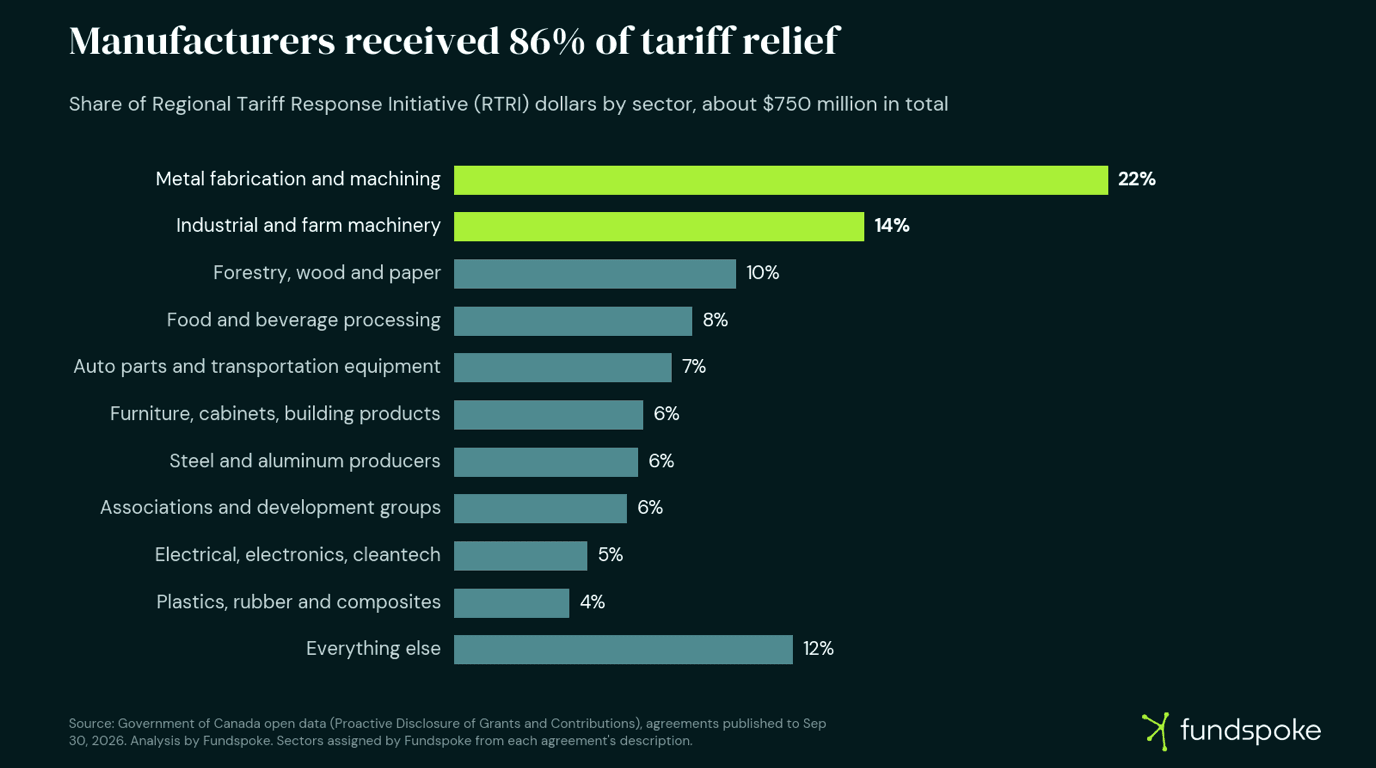
Manufacturers received 86% of the $750 million in RTRI funding that federal agencies have disclosed so far, and most of it paid for equipment and automation. Machine shops, metal fabricators and tool and die makers received more than any other group. Across all federal programs, agencies have now published about $1.2 billion in grants and contributions answering the US tariffs, across about 850 agreements up to September 30, 2026.
Budget 2026 update. The federal budget, tabled November 5, 2026, says RTRI has supported nearly $1.2 billion in investments for about 1,200 businesses since fall 2025. Agencies publish agreements after they’re signed, so the open data trails that total. Read our figures as the pattern of where the money has gone, not the full amount.
We went through every published agreement to see who received the money, what it paid for and how large each one was. If you run a machine shop, build machinery or make anything else, and US tariffs have hit your orders or your costs, the pattern shows what the regional development agencies have been funding so far.
How we counted. The figures come from the Government of Canada’s open data on grants and contributions, which federal departments and agencies publish every quarter (you can search it yourself here). We removed double counts and agreements unrelated to the 2025-26 tariffs, then sorted each agreement by sector and purpose from its description. PacifiCan and PrairiesCan publish RTRI agreements under a general program name, so their totals count only the companies those agencies have announced under RTRI. Treat the western figures as a floor. Dollar figures are the value of each signed agreement, not money paid out so far.
How RTRI grew to $3.45 billion
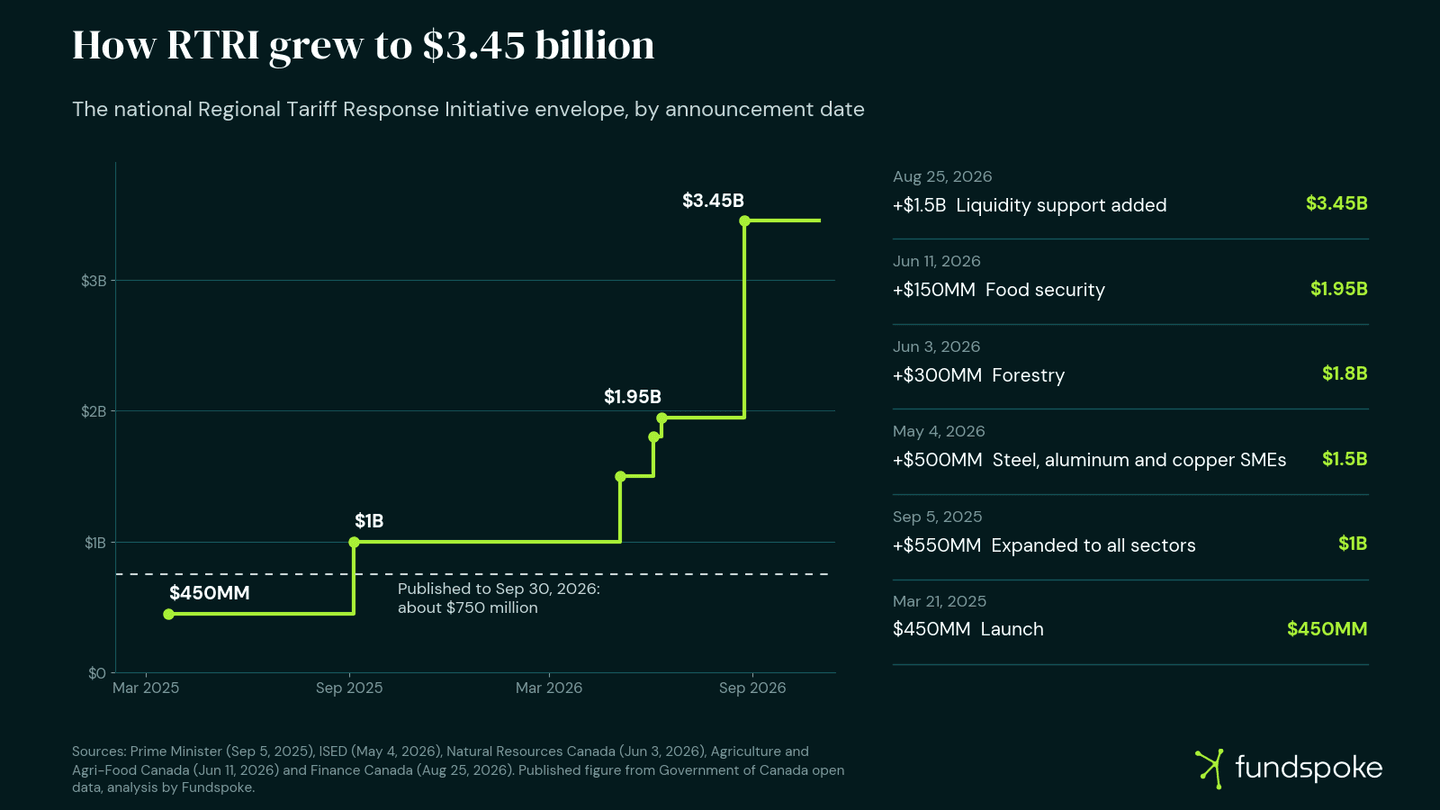
The envelope grew in six steps as the tariffs widened. It started at $450 million in March 2025 and reached $1 billion in September 2025, when it opened to all sectors. Three top-ups in May and June 2026 added $950 million, with money set aside for steel, aluminum and copper companies, for forestry and for food security. Then $1.5 billion more on August 25, 2026 added liquidity support.
RTRI’s $3.45 billion runs through the seven regional development agencies. The Strategic Response Fund for larger companies, including its new $2 billion Canada Strong Diversification Fund stream, is separate, as are the BDC and EDC tariff programs.
Manufacturers received 86% of RTRI dollars
Machine shops, metal fabricators and tool and die makers received about 22% of RTRI dollars, more than any other group. Industrial and farm machinery makers were next at 14%, followed by forestry, wood and paper companies at 10% and food and beverage processors at 8%.
Software and professional services companies received less than 1%. That fits the tariffs themselves, which hit steel, aluminum, autos, lumber and the companies that buy from and supply those industries.
Machine shops and machinery makers: a closer look
Machine shops and machinery makers at a glance. 345 RTRI agreements worth about $272 million, or 36% of RTRI dollars. The typical agreement is $750,000, about one in four is exactly $1 million, and 64% of the dollars paid mainly for equipment and automation.
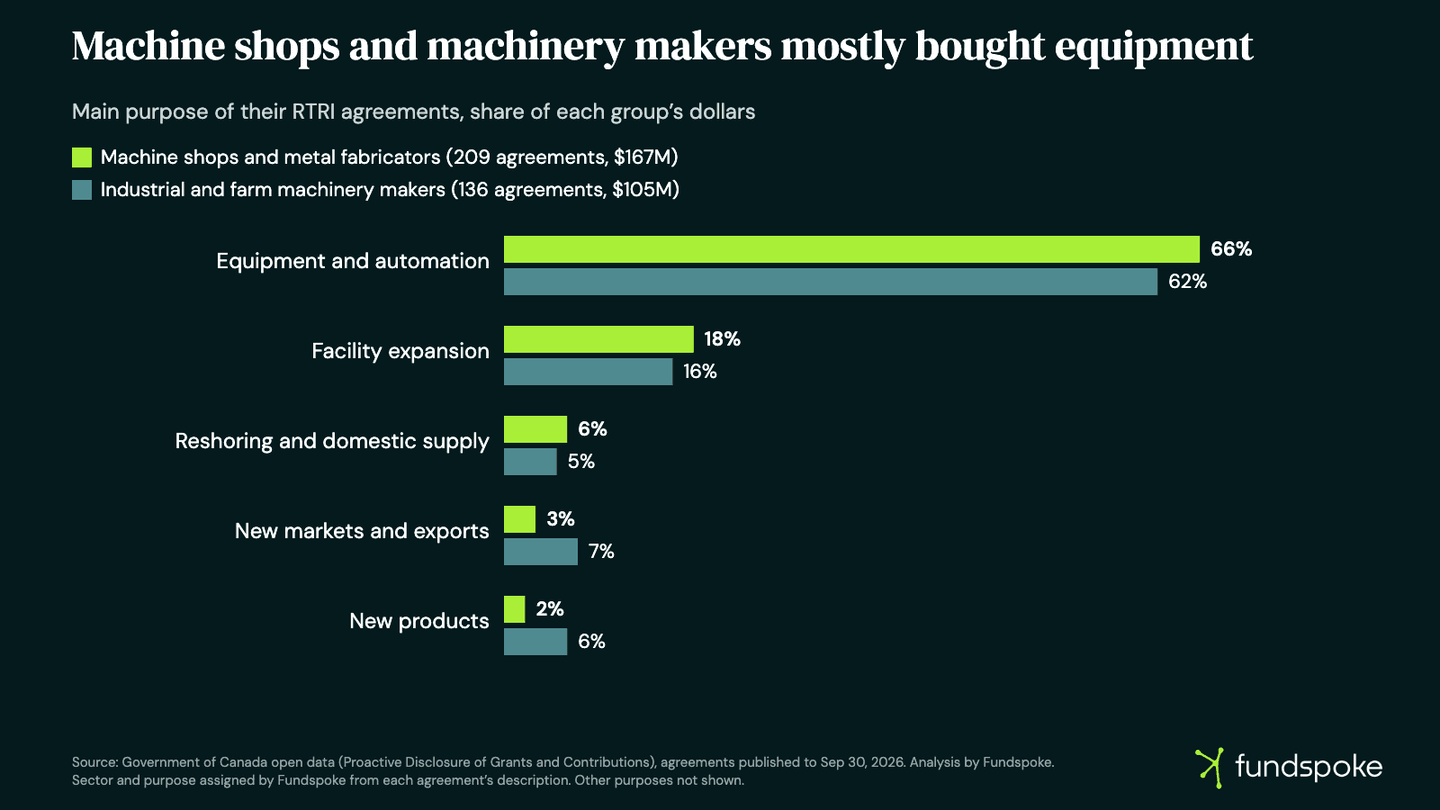
In our analysis, the two groups use the money a little differently. Machine shops and metal fabricators put 66% of their RTRI dollars into equipment and automation and 18% into expanding a facility. Machinery makers lean further toward new customers, and 43% of their agreements name new markets or diversification, against one in three across RTRI as a whole.
Where they are differs too. Ontario companies received 46% of the machine shop and fabrication dollars and Quebec companies 34%. For machinery makers it flips, with Quebec at 46% and Ontario at 27%.
Running a machine shop or building machinery? Our guides to tariff relief for machine shops and tariff relief for machinery and equipment manufacturers cover the tariffs on your inputs and your customers, and the projects that tend to fit.
Most of it paid for equipment and automation
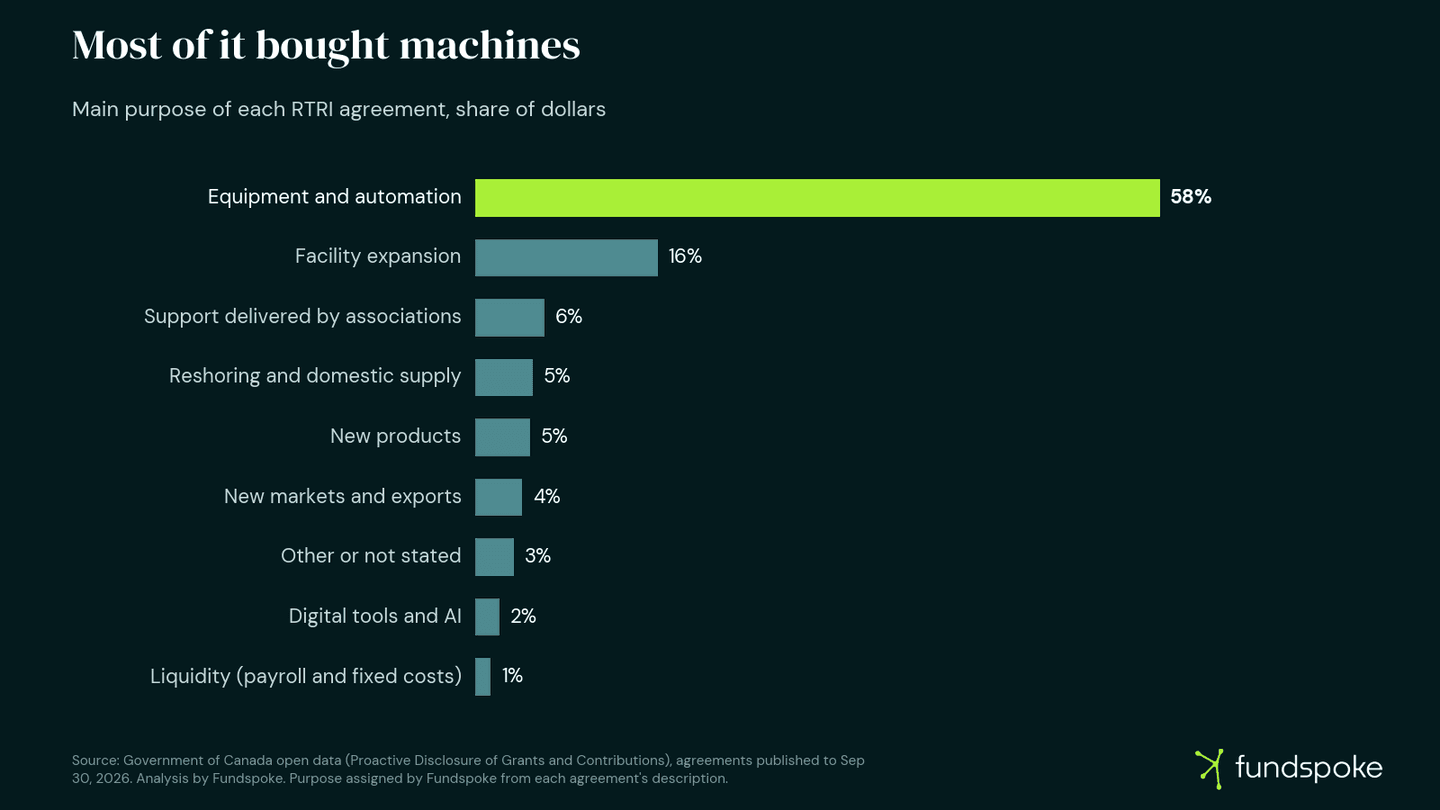
58% of RTRI dollars paid mainly for equipment and automation, and another 16% for expanding a facility. The project descriptions read like capital plans: new machining centres, robotic welding cells, automated packaging lines, modernized kilns and planer lines.
Many projects look past the hit itself. One in three agreements names new markets or diversification, and about one in ten names reshoring or domestic supply, such as making in Canada a part that used to come from the US. “Fund the response, not just the damage” is a fair summary of what the agencies have backed.
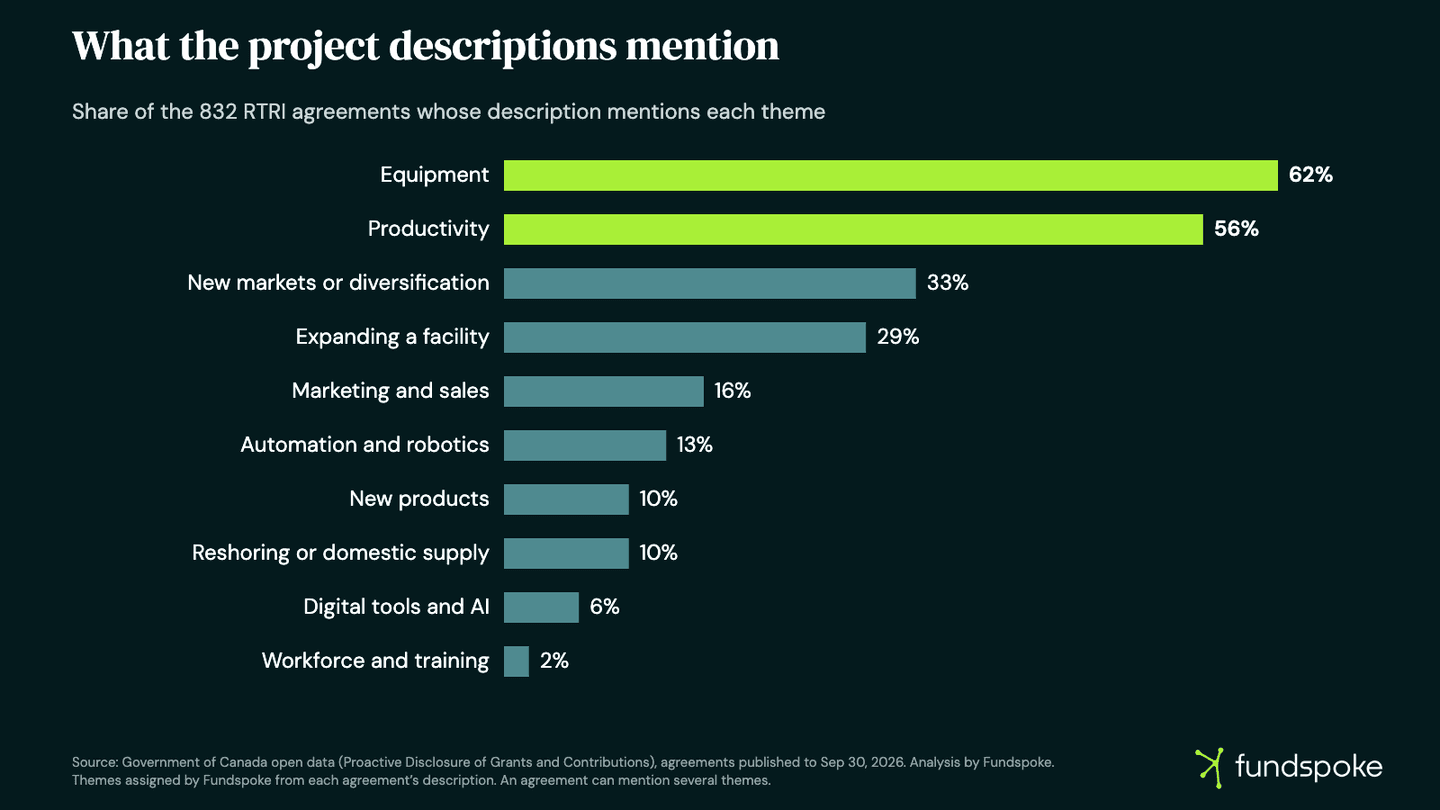
Productivity runs through most of them. In our analysis, 56% of agreements mention productivity, and about one in eight names automation or robotics specifically.
The typical agreement is $750,000
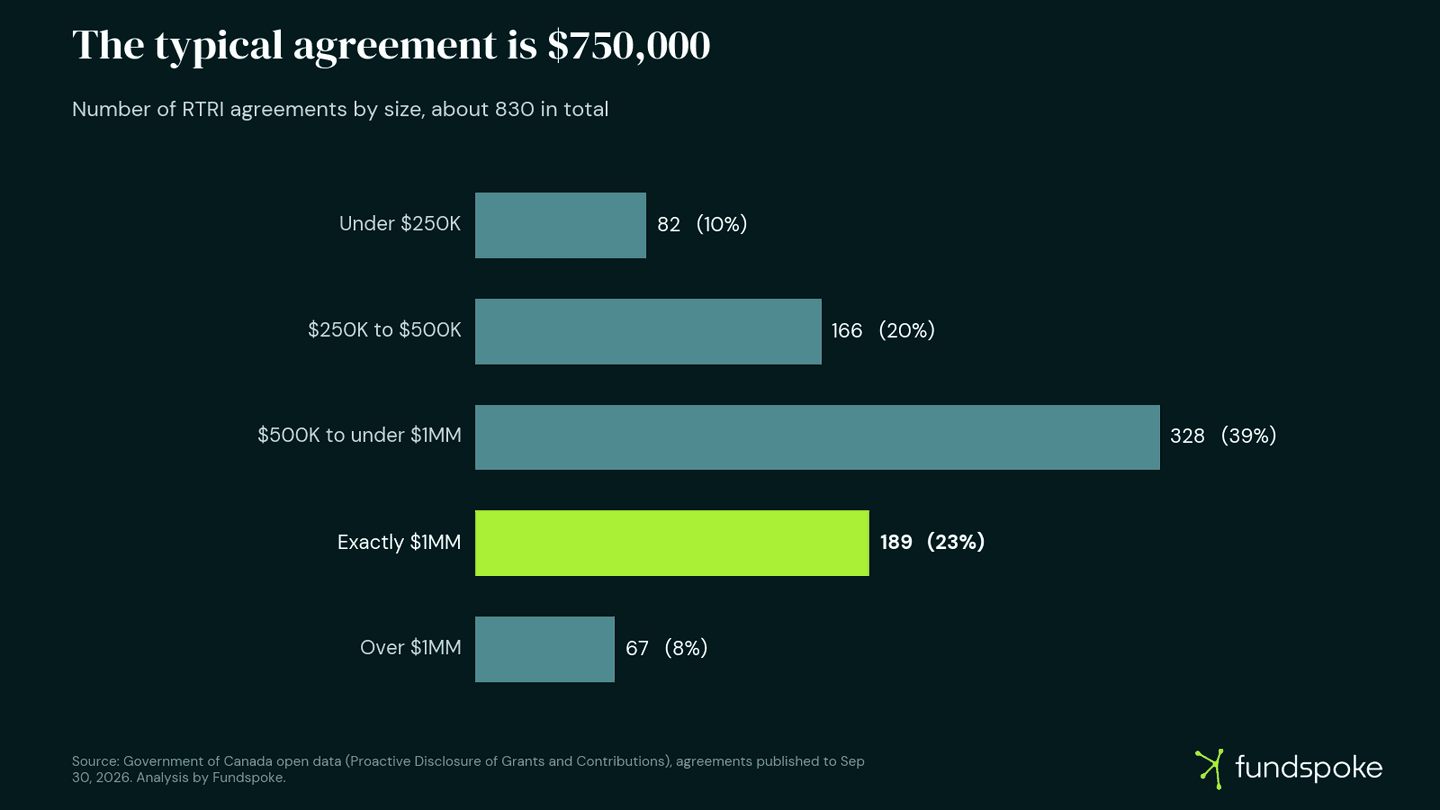
The median RTRI agreement is $750,000, and nearly one in four is exactly $1 million, the most a pivot project can receive as a non-repayable contribution under the current terms. One in ten is under $250,000.
That matters for planning. RTRI pivot funding covers up to 50% of eligible costs, so a $750,000 agreement points to a project of $1.5 million or more. The $1 million revenue minimum is a threshold for the business, not a minimum project size, but most funded projects are real capital investments.
Ontario and Quebec received two thirds
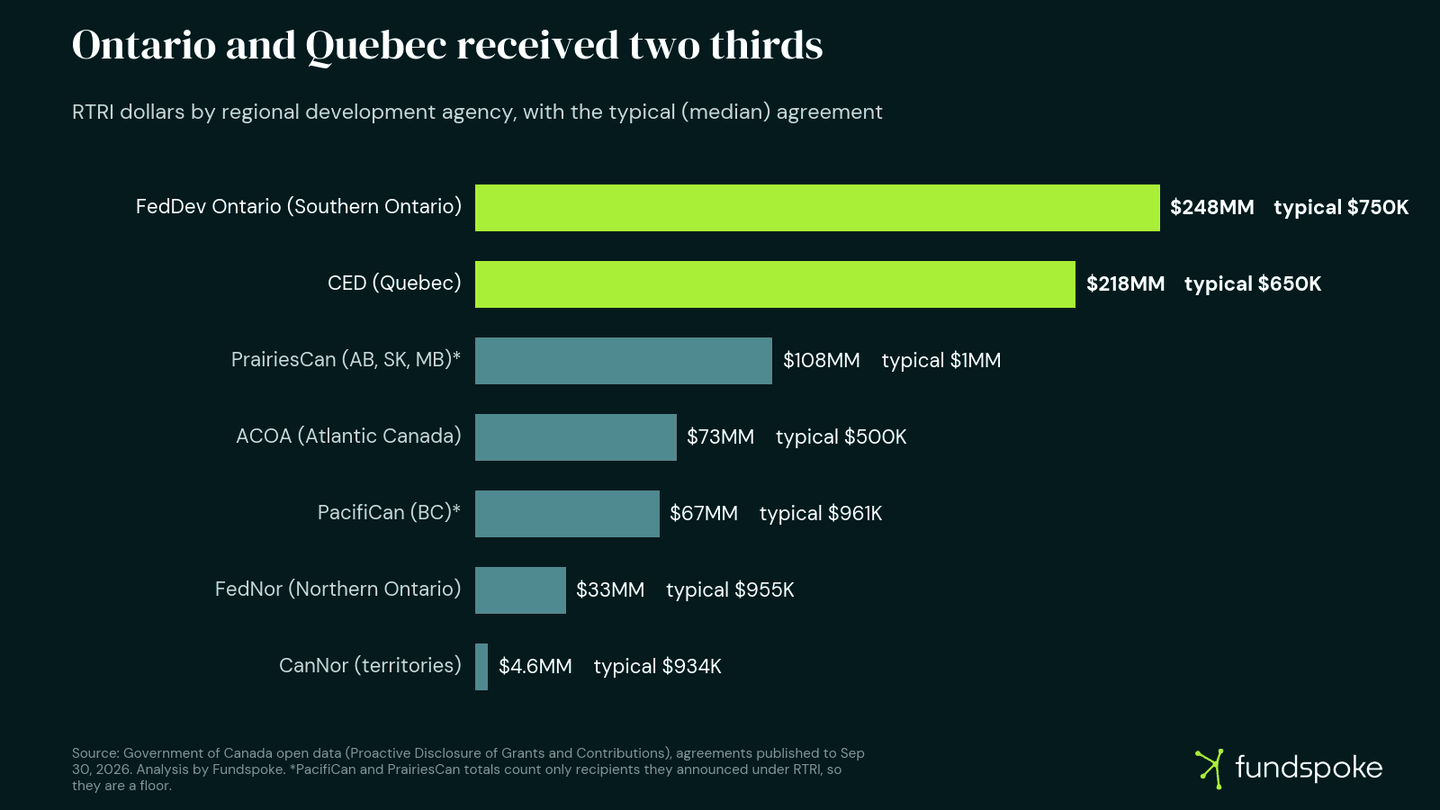
Companies in Ontario and Quebec received two thirds of RTRI dollars. FedDev Ontario has published about $248 million in agreements and CED Quebec about $218 million, with CED signing the most, about 300. Agreement sizes differ by region. PrairiesCan’s typical agreement is $1 million, twice ACOA’s $500,000.
Why the western figures are a floor. PrairiesCan and PacifiCan publish RTRI agreements under their Regional Economic Growth through Innovation (REGI) program, so we count only the companies they have named in RTRI announcements, about $175 million between them. From December 2025 to September 30, 2026, the two agencies also published about $239 million in other agreements with businesses that no RTRI announcement names, and some of that is likely RTRI. Five more RTRI recipients they’ve announced, worth about $19 million, aren’t in the federal data yet.
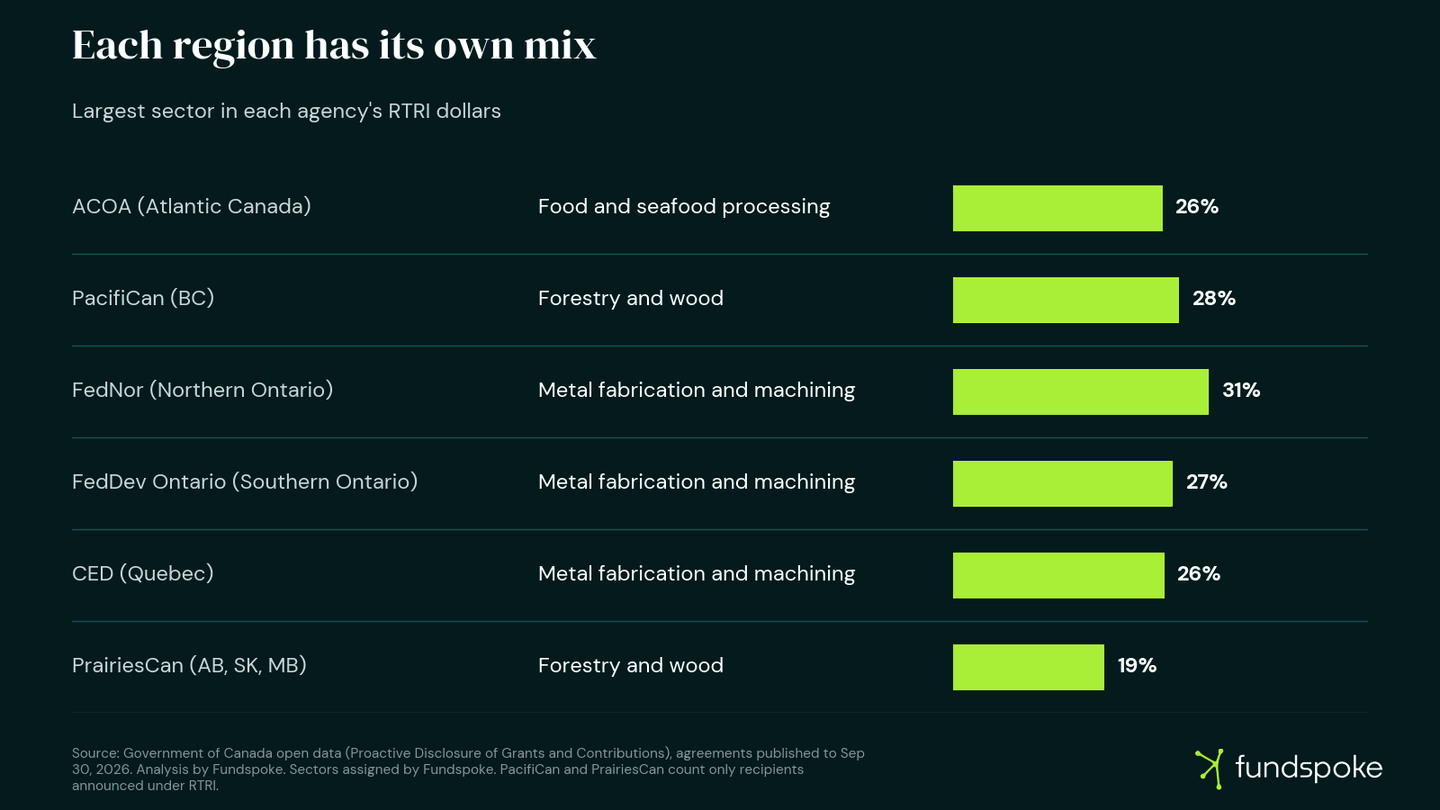
Each region’s money follows its economy. Food and seafood processors received about a quarter of ACOA’s RTRI dollars. Forestry and wood companies received 28% of PacifiCan’s, and metal fabricators and machine shops 31% of FedNor’s.
The largest agreements went to steel and aluminum
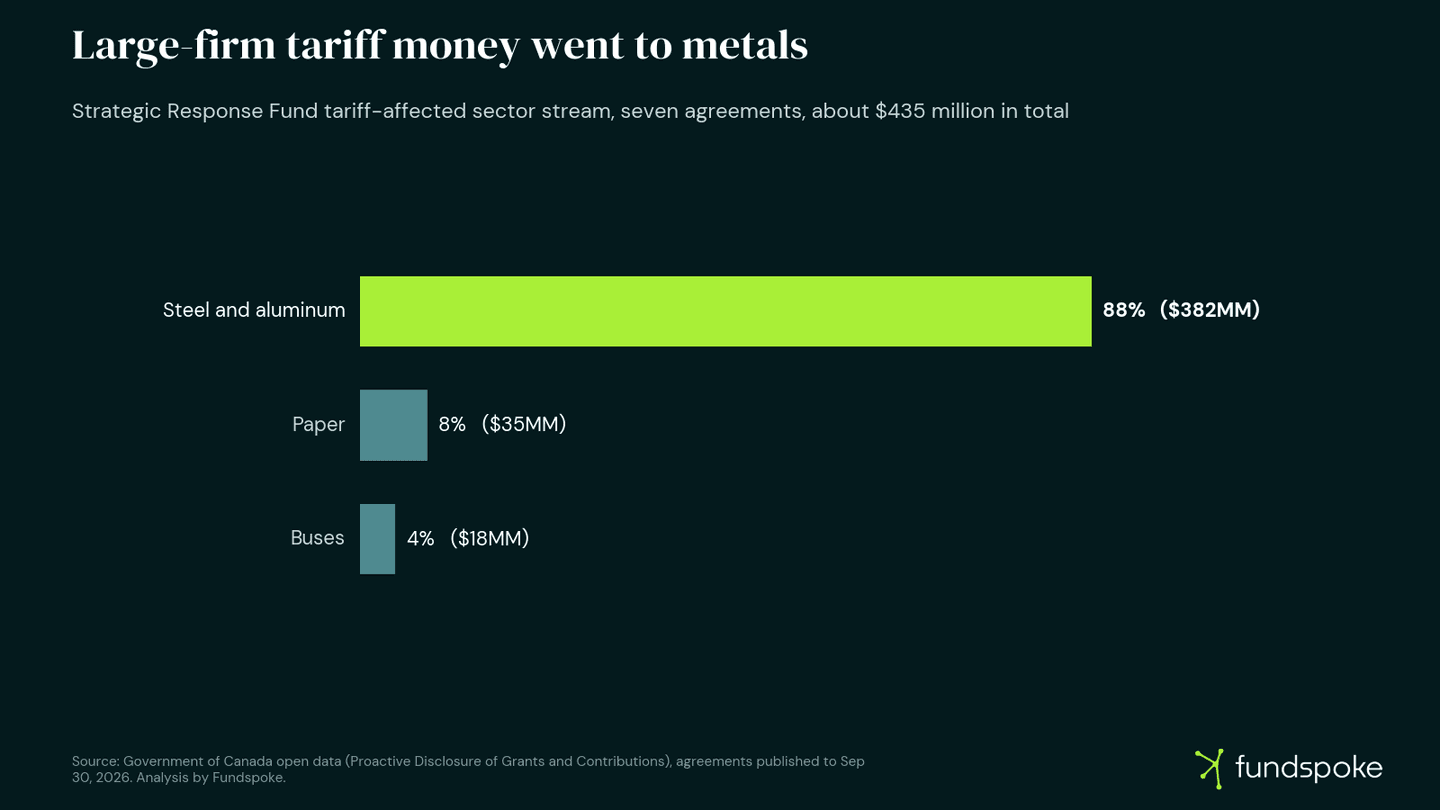
Large projects run through a different program, separate from RTRI’s $3.45 billion. Innovation, Science and Economic Development Canada’s Strategic Response Fund (SRF) has published seven agreements in its tariff-affected stream, worth about $435 million. 88% went to steel and aluminum, and six of the seven are in Quebec.
The SRF’s general rule is a minimum contribution of $10 million on $20 million or more of eligible costs, so it suits few owner-run companies. It does show where the largest tariff dollars have gone so far.
What hasn’t shown up yet
Published agreements lag commitments. Agencies publish each quarter’s agreements after the quarter closes, so approvals since September 30 aren’t in these figures, and commitments run ahead of what’s published.
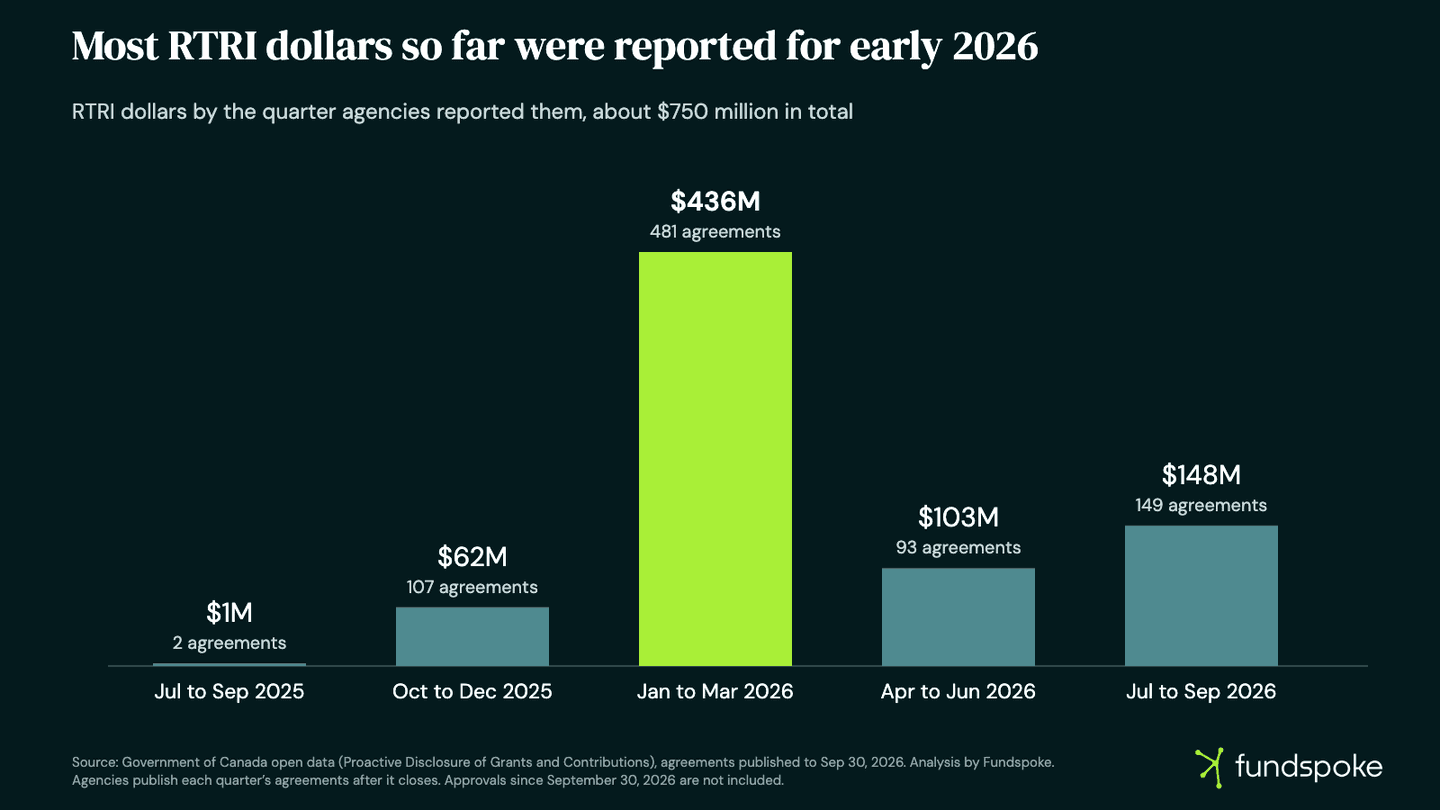
Agencies reported $436 million, more than half of the RTRI dollars so far, for January to March 2026. The quarter to September 30 added about $148 million across about 150 agreements.
Most of the money is also new. $2.45 billion of the $3.45 billion was announced from May 2026 on, including $1.5 billion on August 25, 2026, so the published totals will keep growing as those agreements are signed.
Liquidity support has barely started to show. Only five published agreements are liquidity support. The expanded liquidity stream opened on September 8, 2026, and can provide up to $2 million non-repayable, based mainly on 50% of average monthly payroll for up to 12 months.
Industry associations, chambers and economic development organizations also received about $44 million in RTRI funding to deliver tariff help to other companies. If you belong to an industry or export association, ask what it’s running.
What this means for your company
- A capital project is the strongest fit. Equipment, automation and added capacity account for most of the dollars so far. If a new line, a machine or an automation project is on hold because of tariffs, start there.
- Size it honestly. The typical agreement is $750,000 on a project of $1.5 million or more. Smaller projects are funded too, but the agencies are mostly backing real capital investment.
- Build the evidence before the application. Supplier notices, changed invoices, customer emails, cancelled or delayed orders and margin comparisons show how tariffs reached your business. You don’t have to export to the US to be affected.
- Look at liquidity on its own. Liquidity support is based on payroll and doesn’t need a project. If you’re carrying your crew through a soft year, it may help.
- Check your own agency. RTRI runs through seven regional development agencies, and intake rules and dates differ. Our tariff relief guide lists each one. PrairiesCan, for example, has published an intake end of December 31, 2028, or when funding runs out.
- Ask your association. Many received funding to help members with tariff impacts.
Our take: who this is for, and who it isn’t
A good fit. An established Canadian company with $1 million or more in revenue, a documented tariff impact on its orders, costs or supply chain, and a project it would do with help. Manufacturers in metal, machinery, wood, food and auto parts have received most of the money so far.
A weaker fit. Businesses under $1 million in revenue, companies that can’t show how tariffs reached them, and service or software companies looking for general support, which have received less than 1% of RTRI dollars. Agencies decide each file, and meeting the eligibility rules doesn’t guarantee approval.
If US tariffs have hit your orders or your costs and you have a project in mind, book a free 30-minute call with a senior advisor. We’ll tell you plainly whether RTRI may fit, what it would take and which agency handles your region. Book a free call.
Regional Tariff Response Initiative (Southern Ontario)
Liquidity assistance and pivot project terms. Each of the seven regional development agencies has its own RTRI page.
Figures from Government of Canada open data (Proactive Disclosure of Grants and Contributions), agreements published to September 30, 2026, analyzed by Fundspoke. Envelope history from the federal announcements of March 21, 2025 to August 25, 2026. Program terms from the agency RTRI pages and the Strategic Response Fund eligibility check, reviewed November 3, 2026. Contains information licensed under the Open Government Licence – Canada.