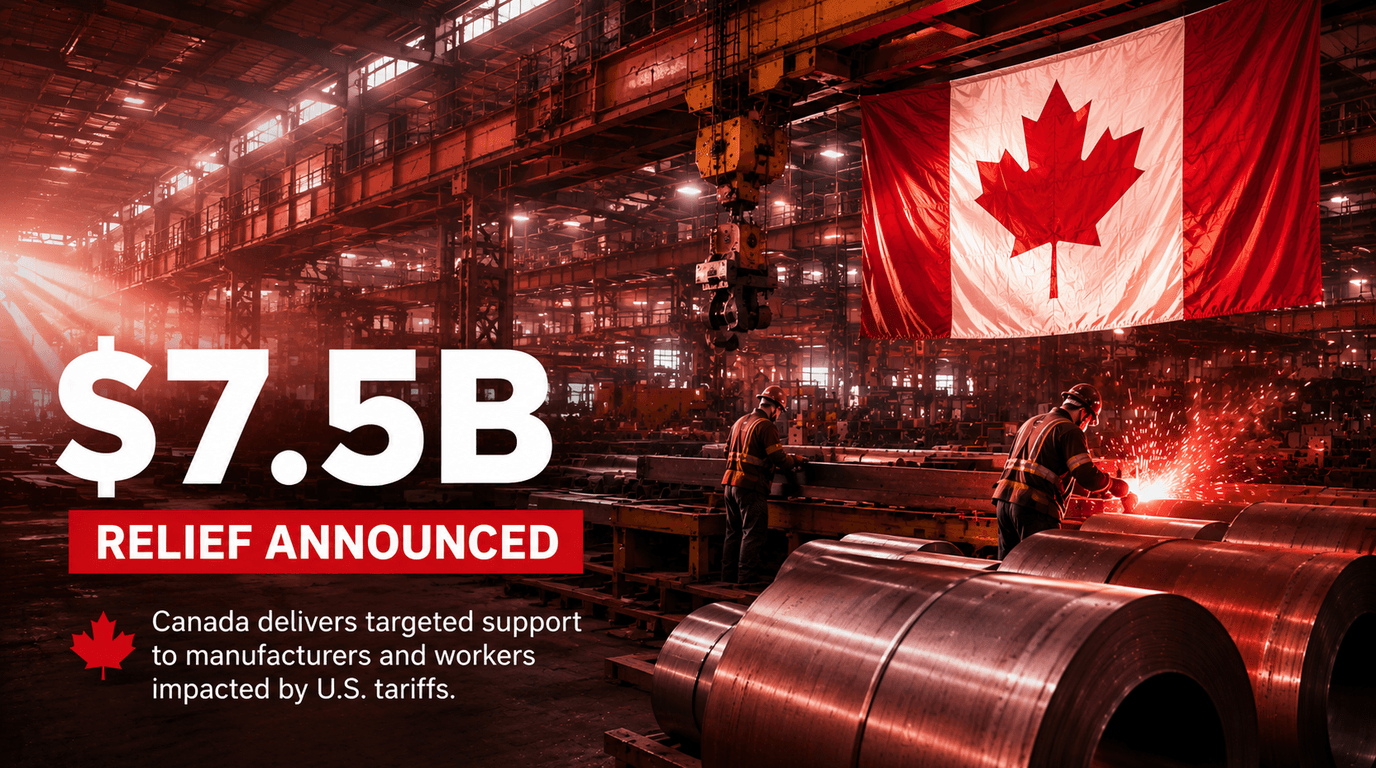
The short version. Canada’s counter-tariffs are confirmed at 15, 25 and 50 per cent on $27.6 billion of US goods, in force September 8. Alongside them, Ottawa announced $7.5 billion in new and enhanced support. The RTRI non-repayable ceiling triples from $1 million to $3 million, and RTRI can now fund liquidity up to $2 million rather than only projects. BDC’s minimum revenue drops to $1 million. A new $2 billion Canada Strong Diversification Fund is open immediately.
Three days ago we wrote that the counter-tariff schedule would land within days and that the support side had been widening every few months. Both arrived on August 25. This is what changed, and which parts matter if you manufacture, fabricate, process or export in this country.
The counter-tariffs are not a flat 50 per cent
This is the detail most coverage compressed, and it changes your landed-cost model. Canada is matching Washington rate for rate, not at a single headline number. Effective September 8, counter-tariffs of 15, 25 and 50 per cent apply to products drawn from those the US targeted under Section 338 and Section 232, with each Canadian rate mirroring the corresponding American one, across $27.6 billion of US imports.
- 50 per cent: steel and aluminum products that were previously subject only to a 25 per cent counter-tariff, plus furniture, clothing and apparel
- 25 per cent: appliances, dairy products such as cheese, fish and seafood, and certain steel and aluminum derivative products
- 15 per cent: the lowest tier, applied where the corresponding US rate is lower
- Unchanged: existing counter-tariffs, including those on autos, remain in place
Do not overlook the last line of the government’s quick facts: Canada’s tariff remission framework remains available to assess requests for exceptional relief. If a tariffed input has no Canadian or non-US substitute and the cost is material to your operation, remission is a separate route worth pricing alongside the funding programs below.
The $7.5 billion in tariff relief, program by program
The package sits on top of the nearly $25 billion provided over the previous 18 months. Four of the five components are directly relevant to an operating company.
1. RTRI: the grant cap triples, and liquidity becomes eligible
An additional $1.5 billion goes into the Regional Tariff Response Initiative effective September 2026, delivered as always by the seven regional development agencies. That takes the RTRI to roughly $3.45 billion, from $450 million at launch in March 2025.
- The cap on non-repayable contributions rises from $1 million to $3 million
- Eligible use now includes demonstrated liquidity needs, in addition to the existing pivot and capital investment plans
- Liquidity support of up to $2 million is available within that ceiling
Read the second bullet twice. Until now, RTRI paid for a project: new equipment, a new line, a qualified second supplier. A company whose problem was simply a squeezed margin had little to apply for. That company is now inside the program, and can ask for non-repayable money against a demonstrated cash-flow gap.
2. BDC: a second liquidity stream and a much lower revenue floor
A second $500 million liquidity stream opens under BDC’s Pivot to Grow program, for working capital against tariff-driven cash-flow shortfalls.
- Open to companies directly impacted by tariffs, regardless of sector
- Loans from $250,000 to $5 million, with interest-only payments over 36 months
- A deliberately simplified application process
- The minimum annual revenue for BDC’s tariff programs drops to $1 million, covering Pivot to Grow and the targeted steel, aluminum and forestry facilities
That last point is the one to act on. BDC’s metals facility previously required $5 million in revenue. A great many fabricators and processors who were told they were too small are eligible today. Two conditions on BDC’s own program page do not appear in the government backgrounder and catch people out: at least 15 per cent of sales must come from exports to the US, and a resilience plan is mandatory.
3. Canada Strong Diversification Fund: $2 billion, open now
Effective immediately, the government created the Canada Strong Diversification Fund as a new stream of the Strategic Response Fund, with an additional $2 billion. That takes the SRF envelope to roughly $7 billion.
- Funds shovel-ready projects, including ongoing capital maintenance, which is unusual for a federal program and much easier to evidence than a greenfield expansion
- Explicitly open to medium-sized firms, not only the large transformative files the SRF is known for
- Intake and triage run through the regional development agencies, so the RTRI conversation and this one are the same conversation
- A fast-track, one-step review and approval process
4. $3.5 billion in Rapid Response Supports for workers and employers
If your plan involves holding a skilled crew through a soft two quarters rather than laying them off, this is the part to read. On the worker side:
- The one-week EI waiting period waiver is extended by one year
- The measure letting workers draw EI without first exhausting separation payments such as severance or vacation pay is extended by one year
- The extra 20 weeks of EI regular benefits for long-tenured workers is extended by eight months
- New for one year: workers who voluntarily left a job in recent months are no longer penalized when accessing EI, provided their most recent job loss was through no fault of their own
- Enhanced job matching on JobBank.gc.ca, surfacing roles created by major projects, Build Canada Homes and defence procurement
On the employer side, the EI Work-Sharing program and the Worker Retention Grant merge into a single Workforce Retention and Retraining Program, described as more accessible and more generous than either predecessor. Existing and new Work-Sharing flexibilities carry over, and employers become eligible for additional funds covering training and administrative costs of up to $1,000 per participant.
A naming inconsistency worth knowing if you are searching for this: the Finance Canada backgrounder calls it the Workforce Retention and Retraining Program, while the news release issued the same day calls it the Worker Retention and Retraining Program and gives the acronym WRRP. They are the same program. Expect the guidance to settle on one.
5. LETL: longer coverage, longer term
For large employers, the Large Enterprise Tariff Loan facility, now confirmed at $10 billion and administered by the Canada Enterprise Emergency Funding Corporation, gains two flexibilities: liquidity support sized to 36 months of company need instead of 24, and a maximum loan term extended from 10 to 15 years. The eligibility bar is unchanged at approximately $150 million or more in annual Canadian revenue.
The real shift is that liquidity is now fundable
Take the four components together and a pattern appears that no single announcement line states outright.
Every federal tariff program to this point was built around a project. You told Ottawa what you were going to build, it co-invested in the capital, and you ended up with more capacity than you started with. We have written that repeatedly, because it was true: nobody was writing cheques to reimburse duties.
That is no longer the whole picture. RTRI liquidity support of up to $2 million, the new BDC stream, and capital maintenance under the Diversification Fund all pay for holding on, not expanding. Ottawa has evidently concluded that a good number of viable companies will not survive to build anything if the cash-flow gap is not bridged first.
The practical consequence is specific. If you assessed these programs earlier in 2026, concluded you had no capital project to put forward and moved on, your conclusion is now out of date. A demonstrated tariff-driven cash-flow gap is, by itself, the basis of a file. That is a genuinely different program design from the one that existed a week ago.
Where the totals now stand
- RTRI: roughly $3.45 billion, up from $1.95 billion, with a $3 million non-repayable ceiling
- Strategic Response Fund: roughly $7 billion, including the new $2 billion Canada Strong Diversification Fund
- LETL: $10 billion, covering 36 months of liquidity over terms up to 15 years
- BDC tariff envelopes: $1 billion for steel, aluminum and copper, $1.2 billion for softwood lumber guarantees, $10 million to $25 million per file for forestry, and Pivot to Grow now carrying two streams
- Worker and employer supports: $3.5 billion in the new Rapid Response suite
Regional Tariff Response Initiative
Roughly $3.45B delivered by the seven regional development agencies. Up to $3M non-repayable, now including up to $2M for demonstrated liquidity needs.
Canada Strong Diversification Fund
A new $2B stream of the Strategic Response Fund for shovel-ready projects and ongoing capital maintenance, with a fast-track one-step review.
BDC Pivot to Grow
$250K to $5M in working capital, interest-only for 36 months, any tariff-hit sector. Minimum revenue now $1M; needs 15% of sales from US exports and a resilience plan.
What to do between now and September 8
- Re-run the eligibility question if you were previously too small. The BDC revenue floor moving to $1 million reopens the door for a lot of fabricators and processors.
- Evidence the cash-flow gap properly. Liquidity support requires a demonstrated need: volume, margin compression, landed cost, customer concentration, and a forward view. This is now the evidentiary core of an RTRI file, not just background.
- Price the counter-tariff schedule against your inputs. Three rates, not one. Check which tier each of your US-sourced inputs falls into before September 8.
- Check whether remission is the better instrument. If a tariffed input has no substitute, the remission framework may serve you better than a loan.
- Decide between liquidity and capital, then sequence. They are not mutually exclusive, but a liquidity request and a capacity expansion are different files with different evidence.
- If you are holding a crew, look at Work-Sharing now. The merged Workforce Retention and Retraining Program is more generous than what it replaced, and $1,000 per participant toward training is real money on a 40-person floor.
Our read
The tripled grant cap will get the attention, and it deserves some: $3 million non-repayable is a materially different proposition from $1 million. But the eligibility changes matter more than the ceiling. A lower BDC revenue floor and a liquidity pathway inside RTRI together widen the pool of companies with a viable file far more than a higher cap does, because a cap only helps companies that already qualified.
The government also said, in as many words, that it will keep assessing programs and expanding the availability of existing measures to newly impacted sectors. Read that as a standing signal: if your sector is not named today and the tariffs bite, the eligibility perimeter has been moving every few months in one direction.
If you are tariff-exposed, we can usually tell you in one conversation whether you have a file worth putting forward and which instrument fits. Talk to our team.