Ontario’s Forest Biomass Program is one of the more significant provincial funding programs that most companies in the sector don’t know about. It supports projects that increase long-term wood utilization across Ontario, with a focus on underutilized species and forest biomass. The program implements Ontario’s Forest Sector Strategy and Forest Biomass Action Plan, positioning the province as a leader in the circular green economy.
Funding ranges from $100,000 for early-stage feasibility work up to $10 million for facility modernization. There are four distinct streams, each with different eligibility rules, contribution rates, and stacking limits. If your company touches forestry, wood products, bioenergy, or bioproduct manufacturing in Ontario, this program is worth a serious look.
The four funding streams
The program is structured around four streams. Each targets a different stage of the biomass value chain, from early exploration to full-scale manufacturing modernization.
1. Indigenous Bioeconomy Partnerships (IBP)
This stream increases Indigenous participation in forest biomass opportunities. Eligible applicants include Indigenous communities, not-for-profits, and businesses with 51%+ Indigenous ownership or control. It covers studies, planning, capacity development, facility construction, and business expansion. Funding covers up to 80% of eligible costs, to a maximum of $250,000 per project. Stacking with other government programs is allowed up to 100% of total eligible costs.
Example: an Indigenous community in Northern Ontario assessing the feasibility of a district biomass heating system for community buildings, using locally harvested wood waste. The $250K would cover the engineering study, supply chain analysis, and capacity development to manage the system long-term.
2. Exploring Biomass Pathways (EBP)
For companies in the early exploration phase. This stream supports investigatory projects examining the feasibility and economics of biomass technologies — engineering studies, scientific trials, and technical assessments. Contribution rates depend on your partnership structure:
- With Indigenous partner: 80% of costs, max $130,000
- With academic, non-profit, or municipal partner: 70% of costs, max $120,000
- All other projects: 50% of costs, max $100,000
Example: a forest products company partnering with a university to test whether pyrolysis of low-grade hardwood residuals can produce biochar at a commercially viable cost. The EBP stream would cover the engineering study, lab trials, and a preliminary economic model. If results are positive, the company would then apply to IBM for the capital build.
3. Innovative Bioproduct Manufacturing (IBM)
This is where the bigger dollars sit. IBM supports commercialization of new biomass technologies at minimum Technology Readiness Level 5 (demonstration stage). It targets for-profit companies producing bioproducts and focuses on capital investment projects that increase regional biomass utilization. Funding covers up to 50% of eligible costs, to a maximum of $5 million per project.
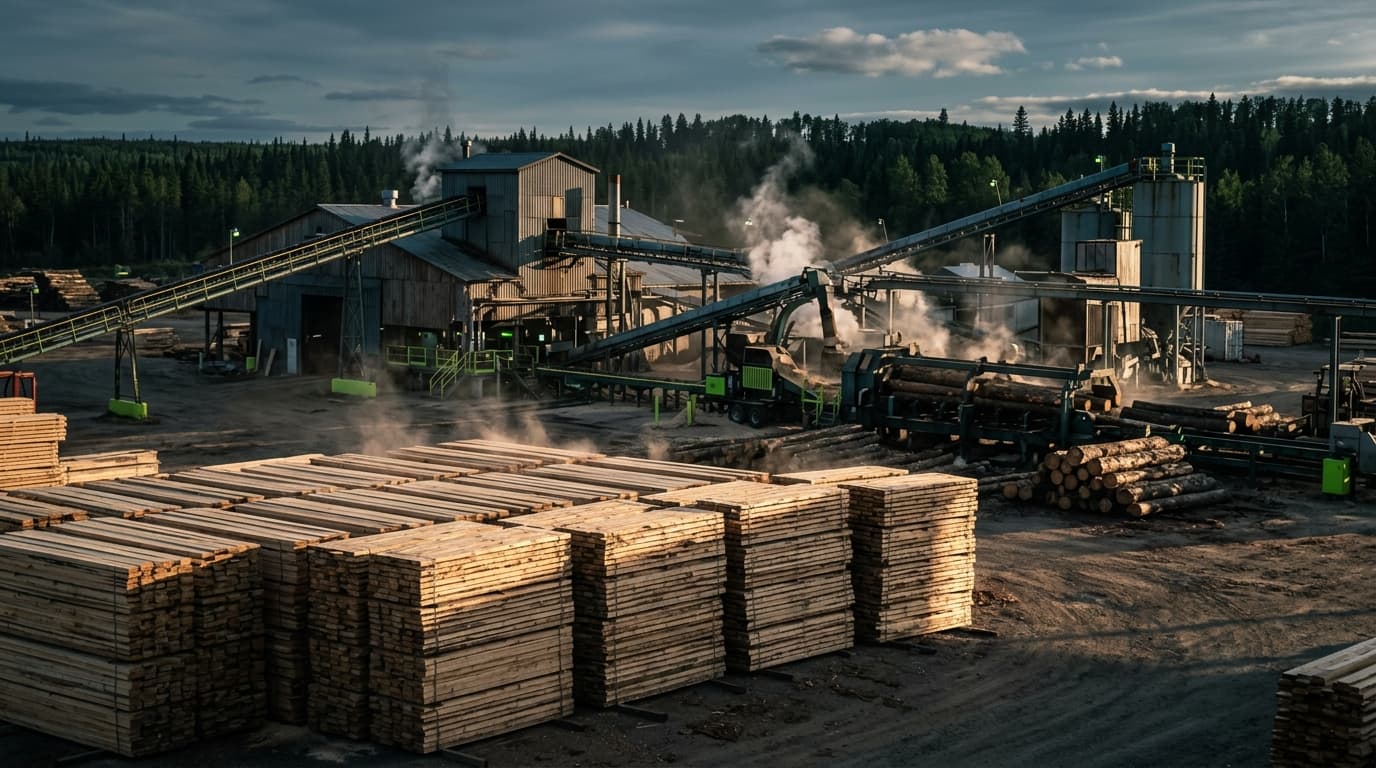
Example: a sawmill adding a wood pellet production line to convert sawdust, bark, and off-cuts into densified fuel pellets. The $5M would cover the pelletizing equipment, drying systems, storage infrastructure, installation, commissioning, and operator training. This is a textbook IBM project — it takes an underutilized byproduct and turns it into a new revenue stream.
4. Modernization (MOD)
The largest stream. MOD supports existing forest product manufacturing facilities looking to scale their biomass use. Applicants must be operating wood product manufacturers consuming significant biomass quantities, with a modernization plan demonstrating supply chain improvements. Funding covers up to 35% of eligible costs, to a maximum of $10 million per project.
Example: a decades-old OSB (oriented strand board) plant upgrading its dryers, conveyors, and screening equipment to handle a wider range of fibre inputs, including species previously left in the bush. The modernization plan would show how the upgrades increase throughput, reduce waste, and bring underutilized species into the supply chain. At $10M, this stream can fund a meaningful share of a multi-million dollar facility upgrade.
The MOD stream requires an independent third-party financial and technical assessment as part of due diligence. IBM projects may also require this depending on complexity. Build the cost and timeline for these assessments into your project plan from the start.
Stacking rules: what you can combine
Stacking rules vary by stream, and this is where careful planning matters:
- IBP projects: Can stack up to 100% of total eligible costs with other government programs.
- EBP projects: Stacking varies by partnership type — 80% for Indigenous partnerships, 70% for academic/non-profit/municipal, 70% for all other applicants, and 100% for non-profits and local government.
- IBM and MOD projects: Can stack up to 75% with municipal and federal programs only. Cannot stack with other provincial programs.
That last point is critical for IBM and MOD applicants. You can layer federal programs like IRAP, the Strategic Response Fund, and SR&ED on top of this program — but not other Ontario provincial programs. Structure your funding strategy accordingly.
What’s eligible (and what isn’t)
The eligible cost categories are broad, but the details matter. Here’s what you can claim:
- Professional services and technical expertise — engineering firms, environmental consultants, third-party assessors
- Salaries, wages, and benefits — for staff directly working on the project (excluding severance)
- Planning and design — architectural plans, process engineering, facility layout
- Capital equipment and machinery — pelletizers, dryers, boilers, screening systems, conveyors
- Rolling stock — harvesting equipment, chippers, grinders, processing machinery (but not trucks or cars)
- Installation and commissioning — getting new equipment operational, including calibration and testing
- Training and skills development — operator training for new equipment or processes
- Materials, permits, and transportation costs — directly tied to the project
For example, a sawmill adding a pellet line could claim the pelletizing equipment, the hammer mill, the dryer, installation and commissioning costs, operator training, and the engineering study that designed the line. That’s a comprehensive claim across multiple cost categories on a single project.
Two caps to watch: overhead is capped at 15% of the total contribution, and in-kind staff contributions are capped at 10% of total eligible costs.
Now, what you cannot claim:
- Land purchases
- Working capital or general operating expenses
- Labour costs for owners with 10%+ equity in the business
- Office equipment (computers, furniture, general IT)
- Vehicle leasing or purchase (trucks, cars, vans)
- Restructuring, mergers, or acquisitions
The vehicle exclusion catches people. You can claim a chipper or a debarker, but not the truck that hauls logs to the plant. Plan your cost breakdown carefully.
Application deadlines and process
Applications are accepted twice yearly. The upcoming deadlines are:
- April 15, 2026 — 11:59 p.m. EST
- October 15, 2026 — 11:59 p.m. EST
Submit completed applications and documentation to forestbiomass@ontario.ca. The program is competitive and discretionary — there is no entitlement to funding, and the ministry reserves the right to impose conditions or decline applications. Do not incur project costs until your funding agreement is executed.
The April 15, 2026 deadline is three weeks away. If you’re considering an application for the IBM or MOD streams, start now. These require detailed business plans, financial projections, and in the case of MOD, a modernization plan demonstrating supply chain improvements.
How projects are evaluated
The ministry evaluates applications on several dimensions: alignment with the specific stream’s objectives, strength of the business plan (financial, technical, and operational capacity), impact on regional economies and Ontario’s broader forest bioeconomy, long-term wood utilization potential, and carbon emission reductions.
They also assess whether government support is critical to the project’s realization. If you can clearly fund the project without government help, your application will score lower. The narrative needs to show that the program funding is the difference between the project happening and not happening — or happening at a meaningfully smaller scale.
Our take: who this program is for (and who it isn’t)
We’ve looked at this program closely, and here’s our honest assessment of who should be applying and who shouldn’t waste the effort.
Good fit
- Established sawmills and wood product manufacturers with underutilized residuals (bark, sawdust, off-cuts, low-grade species) sitting in their supply chain. If you’re already running a mill and want to add a pellet line, a biomass boiler, or a bioproduct facility, the IBM or MOD streams were designed for you.
- Indigenous communities with forestry assets looking to assess or develop biomass opportunities. The IBP stream is well-funded relative to project size, stacks to 100%, and covers capacity development — not just capital. If your community is exploring biomass heating, a small-scale processing facility, or forestry-based economic development, this is a strong fit.
- Companies with a specific capital project already planned that increases wood utilization. The program rewards applicants who can show a clear business plan, defined scope, and realistic timelines. If you’re at the stage where you have engineering estimates and a site, you’re ready.
- Forest products companies exploring new bioproduct categories — biochar, torrefied wood, cellulose insulation, bioplastics from wood fibre. The EBP stream is designed for exactly this kind of feasibility work.
Not a good fit
- Pure technology companies without forestry operations. If you’ve built a biomass conversion technology but don’t have a supply chain, facility, or forestry partner in Ontario, this program isn’t the right starting point. Look at IRAP or the Strategic Response Fund instead.
- Companies looking for working capital or general operating support. This is project-based funding on a reimbursement basis. You incur costs first, then get reimbursed after hitting milestones. If cash flow is the problem, this won’t solve it.
- Small projects under $50K. The application complexity and due diligence requirements make very small projects difficult to justify. The effort-to-funding ratio doesn’t work below a certain threshold.
- Projects that can clearly proceed without government support. The evaluation criteria explicitly assess whether the funding is critical to the project’s realization. If you’re going to build regardless, your application will score lower.
Not sure which stream fits your project? The streams can seem overlapping, but the distinctions matter for your application. IBM is for new bioproduct manufacturing capacity. MOD is for upgrading existing wood product facilities. EBP is for testing whether a technology or business model works before committing capital. Getting the stream wrong can mean a rejection that was entirely avoidable.
How this fits into a broader funding strategy
The Forest Biomass Program doesn’t exist in isolation. For companies in forestry and wood products, it’s one piece of a larger picture. A well-structured project can layer this program with federal contributions from NRC IRAP (for R&D components), the Strategic Response Fund (for large-scale commercialization), SR&ED tax credits (on eligible R&D expenditures), and the Clean Technology ITC (on eligible clean technology equipment).
The key is structuring each application so the cost categories don’t overlap and the stacking limits are respected. That’s project architecture — and it’s the difference between getting funded once and getting funded across four programs on the same project.
If your company operates in Ontario’s forest sector and you’re planning a capital project, feasibility study, or facility modernization, we can help you determine what you qualify for and build the applications.
Ontario Forest Biomass Program
Ontario’s program supporting wood utilization, bioproduct manufacturing, and facility modernization across four funding streams.
The next application deadline is April 15, 2026. If you’re considering an application — or want to know whether your project qualifies — book a call with our team. We can assess fit, recommend the right stream, and help structure your application.