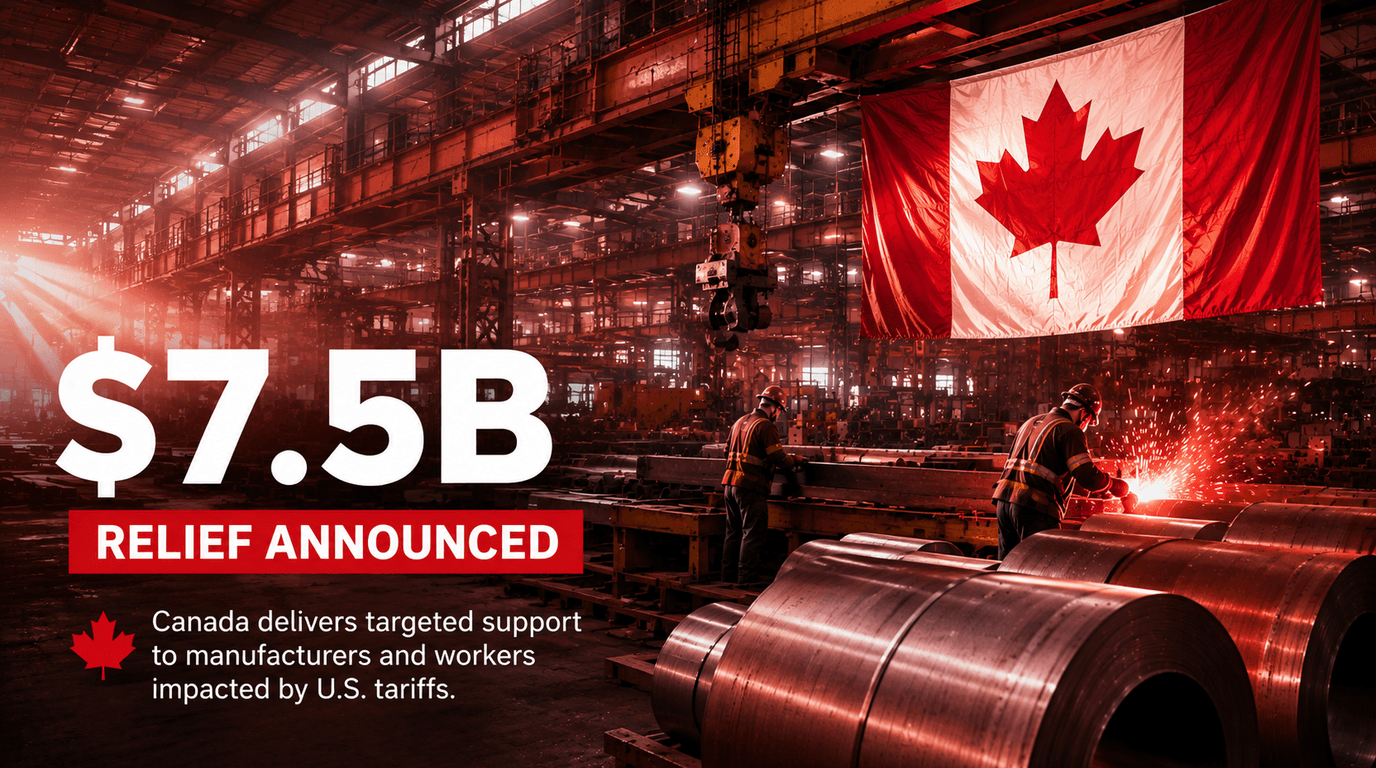
Tariffs raise a Canadian manufacturer’s landed costs, slow and complicate delivery as suppliers reroute around them, and reduce orders from US customers absorbing the same cost increase. The impact of tariffs on supply chain costs is exactly what federal funding through the Regional Tariff Response Initiative (RTRI) exists to offset, whether or not your company exports to the US.
According to a KPMG Canada survey of 275 manufacturers published in July 2026, 57% of Canadian manufacturers have paused, reduced or cancelled capital spending because of tariffs and trade uncertainty, and 42% have already moved production to the US or are weighing it. That’s not a small-business problem. It’s showing up at scale. Here’s where that cost actually lands in your supply chain, and what RTRI will and won’t do about it.
Where Tariffs Hit Your Supply Chain First
Tariffs change your landed cost the moment a shipment crosses the border, but the damage spreads from there. A supplier raises their price to cover the duty. You requalify a second supplier in a lower-tariff country, which takes months and carries its own startup cost. Your US customer either accepts a higher price or finds another source, and either way your margin absorbs some of the difference.
By the third quarter of 2025, the average Canadian worker already had 9% less capital to work with than in 2015, and machinery and equipment per worker was down 20%, according to the C.D. Howe Institute. Tariffs didn’t start that slide, but they’ve made manufacturers more cautious about reversing it.
None of this requires a US customer to say no outright. A customer who quietly shifts 10% of an order to a domestic US supplier shows up the same way on your books as a lost contract: lower volume, the same fixed costs and a margin that has to stretch further.
Why Lean Supply Chains Break First
A supply chain built for speed, not slack, is the one tariffs hurt most. If you run just-in-time inventory with a single supplier per part, a jump in landed cost on one component can stop a production line as surely as a late shipment. You can’t absorb the increase and you can’t swap suppliers overnight, since qualifying a new one for an automotive or aerospace part often takes months of testing.
That’s why most of the standard advice here (sub-tier supplier mapping, scenario-planning software, a bigger supplier base) is really about buying time, not solving the cost problem. It helps you see the exposure coming. It doesn’t pay for the new production line, the requalification work or the payroll you’re still carrying while orders are down.
What the Usual Playbook Misses
Every piece written about the impact of tariffs on supply chain management ends up in roughly the same place: map your suppliers, diversify your sourcing, model a few scenarios, maybe buy software to track it all. That’s sound operational advice, and none of it is wrong.
What it misses is the Canadian-specific piece. If tariffs have cut your orders, raised your input costs or forced you to requalify a supplier, you may already qualify for funding built to cover exactly that gap, whether or not you export to the US at all.
RTRI: The Program Built to Offset Tariff Costs

The Regional Tariff Response Initiative (RTRI) is federal support delivered through Canada’s seven regional development agencies:
- FedDev Ontario
- FedNor
- CED Quebec
- PacifiCan
- PrairiesCan
- ACOA
- CanNor
RTRI has two parts. The first, liquidity assistance, is non-repayable, up to $2M. In practice, agencies size it mainly off your average monthly payroll over the last 12 months, covering up to 50% of that for up to 12 months. It’s meant to cover a cash shortfall, not fund a specific project, so you don’t need a plan in hand to apply.
As an example (not an estimate), a machine shop with $150,000 in average monthly payroll could be looking at up to $900,000 in liquidity support, before the agency’s own review.
The second part, RTRI pivot projects, helps you adapt: automating a line, qualifying a new supplier, entering a new market. It’s non-repayable up to $1M, or repayable and interest-free above that at up to 75% of costs. Combined, non-repayable support across both parts caps at $3M per business.
To qualify for either part, your company needs at least $1M in revenue in one of the last two fiscal years and must have been solvent and operating normally before the tariffs hit. From there, most manufacturers can show impact in more than one way:
- A sales report for your key US customers, comparing the year before tariffs with the year after
- A supplier’s price-increase notice or the invoices that show it
- Your customs broker’s invoices showing the duties you were actually charged
- Documentation that you’re a supply-chain partner to a business that was hit directly
RTRI’s national envelope sits at $3.45B after a $1.5B top-up in August 2026, and liquidity support ends by March 31, 2028.
What RTRI Won’t Cover
RTRI has real limits, and the offset it provides isn’t total. It doesn’t pay the tariffs or duties themselves, and it won’t cover inventory, raw materials or debt payments. It won’t backstop a company that was already struggling before the tariffs hit.
If your highest cost is the duty itself, RTRI isn’t the tool for that directly. What it can fund is the payroll, equipment and new-market work a tariff-hit company needs to keep operating and adapt.
How Fundspoke Builds and Manages Your RTRI File

As a Canadian government funding advisory firm, we work with manufacturers to find the funding that fits their situation, build the application itself, and manage the project after approval, including claims, reporting and compliance.
Every Fundspoke engagement is handled by a senior team of PhDs, CPAs and former founders, the same people who build your file, not a junior who hands it off partway through. Morgan Wyatt, PhD, Fundspoke’s founder, has been on the owner’s side of a funding application himself: he grew Greenlid from one product to 100+ SKUs in 10,000+ stores, and raised more than $5MM in government funding, including support for a new plant that brought production home from China, the same kind of supplier requalification covered above, on the owner’s own numbers and own timeline.
That background shapes how the team works on an RTRI file specifically. The person pulling together your payroll records and cash-flow forecast for a liquidity application, or your customs broker’s invoices and sales reports for a pivot project, has run a manufacturing business and signed the cheques, not just read about one. Across 14+ sectors and 200+ active clients, that’s the team building your file, not a generalist learning the program on your time.
Your Next Step: A Free Call, Not a Commitment
Tariffs are already showing up in your landed costs, your lead times and the orders you’re not getting from the US anymore. RTRI was built to offset exactly that, but liquidity support ends on March 31, 2028, so the window to apply isn’t indefinite.
If you want a senior advisor to work through your eligibility and what the funding could be worth, book a free 30-minute call today.
FAQs About the Supply Chain Impacts from Tariffs and RTRI Support
How do tariffs actually affect a Canadian manufacturer’s supply chain?
Tariffs raise your landed cost the moment a shipment crosses the border, then the effect spreads. A supplier raises prices to cover the duty, you requalify a second supplier in a lower-tariff country, and your US customer either absorbs a higher price or sources elsewhere. Each step eats into margin on its own.
Do I have to export to the US for tariffs to hit my supply chain?
No. A supplier two steps removed from a tariff-hit exporter feels the same cost and delay pressure, even with no direct US sales. Indirect exposure through your customers or your own suppliers counts just as much as a direct hit.
Can my supply chain be affected even if a US customer doesn’t cancel an order?
Yes. A customer who quietly shifts part of an order, say 10%, to a domestic US supplier shows up the same way on your books as a lost contract: lower volume, the same fixed costs and a margin that has to stretch further. The order never has to be cancelled outright for the impact to be real.
What’s the actual cost of requalifying a new supplier?
Beyond the new supplier’s price, requalification carries its own startup cost: testing, documentation and the months it takes before a new part or supplier is approved for production. That cost sits on top of whatever the tariff itself adds, which is why diversifying suppliers helps with exposure but doesn’t solve the cost problem on its own.
Is supplier diversification enough to manage tariff risk?
It helps you see the exposure coming, but it’s really about buying time, not solving the underlying cost. Sub-tier supplier mapping, scenario planning and a bigger supplier base don’t pay for the new production line, the requalification work or the payroll you’re still carrying while orders are down.
How much could my business receive?
It depends on your payroll and the project, but combined non-repayable support across both parts of RTRI caps at $3M per business. As an example, not an estimate, a machine shop with $150,000 in average monthly payroll could be looking at up to $900,000 in liquidity support, before the agency’s own review.